Sidi Bou Said and Carthage in one day: what to see and in what order
Carthage in the morning
Sidi Bou Said in the afternoon
Updated October 2026 · 9 min read
You can see Sidi Bou Said and Carthage in one day comfortably: they are 5 km apart on the same hill above the Gulf of Tunis. Spend the morning at three or four Carthage sites (the Antonine Baths, Byrsa Hill, the Punic ports), then walk up to Sidi Bou Said for lunch and the view. Allow about six hours on the ground.
On this page
Can you really see Sidi Bou Said and Carthage in one day?
Yes, and most visitors do. Carthage is not one fenced site but a dozen scattered ones across a residential suburb, so the trick is to choose four instead of trying to see all of them. Sidi Bou Said sits right next door, which makes it the natural afternoon.
| Stop | Time to allow | What you see |
|---|---|---|
| Antonine Baths | 45 to 60 minutes | The largest Roman baths in Africa, on the sea front |
| Byrsa Hill and museum | 45 minutes | The Punic quarter, the view over both bays, the national museum of Carthage |
| Punic ports | 20 minutes | The circular harbour of the Carthaginian war fleet |
| Roman villas and theatre | 30 minutes | Mosaics in situ and the restored theatre used for the summer festival |
| Sidi Bou Said | 2 to 3 hours | The village, the cafés, the Ennejma Ezzahra palace and lunch |
One ticket covers most Carthage sites. In 2026 it costs 30 TND for foreign visitors, rising to 45 TND from January 2027. Sidi Bou Said itself is free; only the palace and a few museum houses charge a small fee.
What is there to see at Carthage?
Carthage was founded by Phoenicians, according to tradition in 814 BC, destroyed by Rome in 146 BC and rebuilt as the capital of Roman Africa. What you see today mixes both cities: Punic foundations underneath, Roman baths, villas and theatres on top.
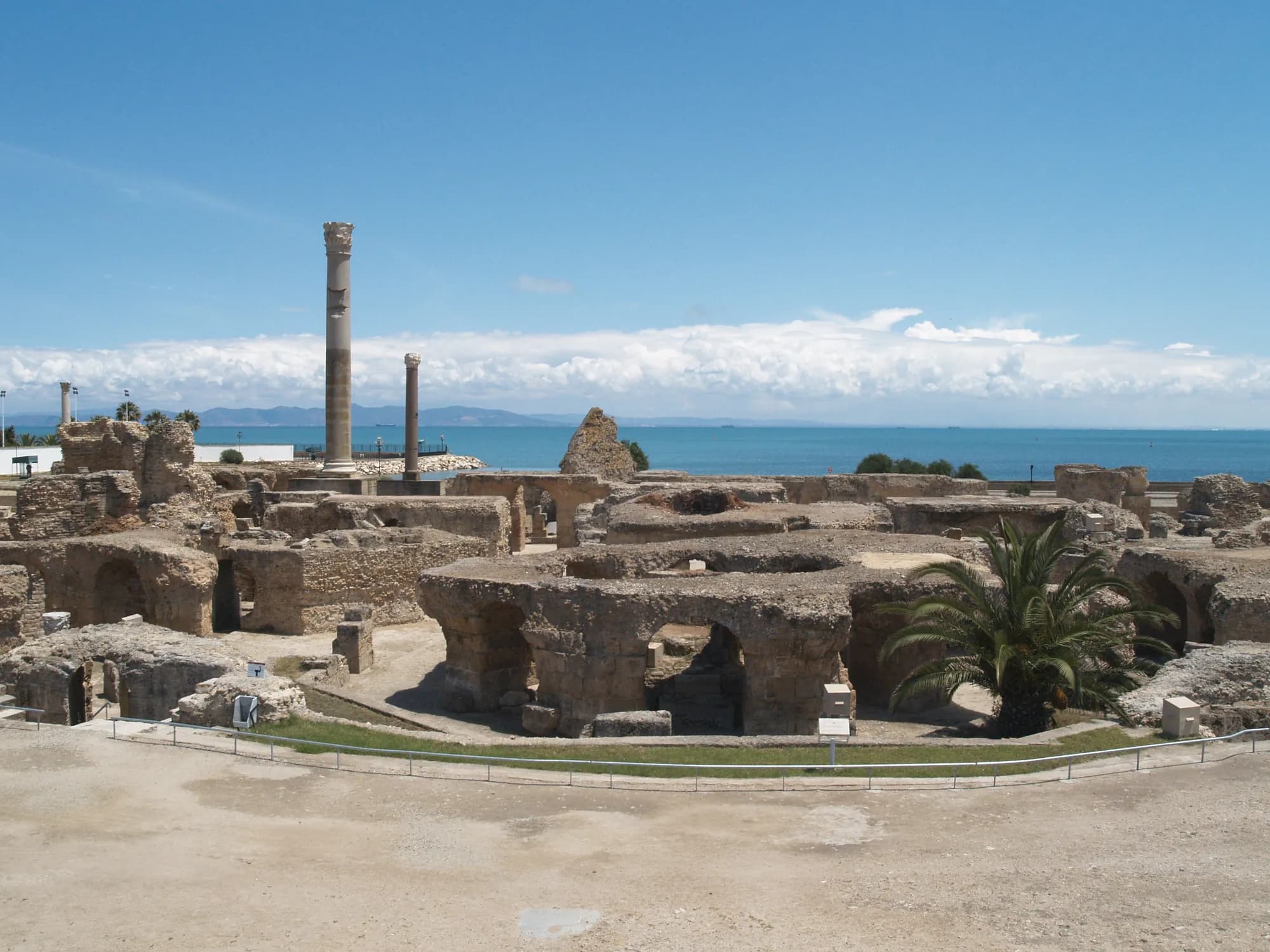
Antonine Baths: built in the 2nd century AD under Antoninus Pius. Only the basement survives, but the columns and vaults give you the scale. Start here, because it is on the sea and cooler early.
Byrsa Hill: the heart of Punic Carthage, with houses from the 2nd century BC, the Carthage museum and the Acropolium, the old Saint Louis cathedral. The view over both bays is the best in the area.
Punic ports: a round lagoon that once sheltered the war fleet in covered sheds. It looks modest; the story behind it is not.
Tophet: the Punic sanctuary with small stelae among the trees. Quiet, moving, and often skipped.
Roman villas and theatre: floor mosaics in place, a short walk from the theatre still used for the Carthage International Festival in summer.
The archaeological site of Carthage has been a UNESCO World Heritage Site since 1979. Do not photograph the presidential palace or its guards, which sit next to the baths.
What to see in Sidi Bou Said
Sidi Bou Said is small: one main street climbing to a café, and lanes branching off it. You can see the essentials in two hours, and you should leave time to sit down, because sitting is half the point.
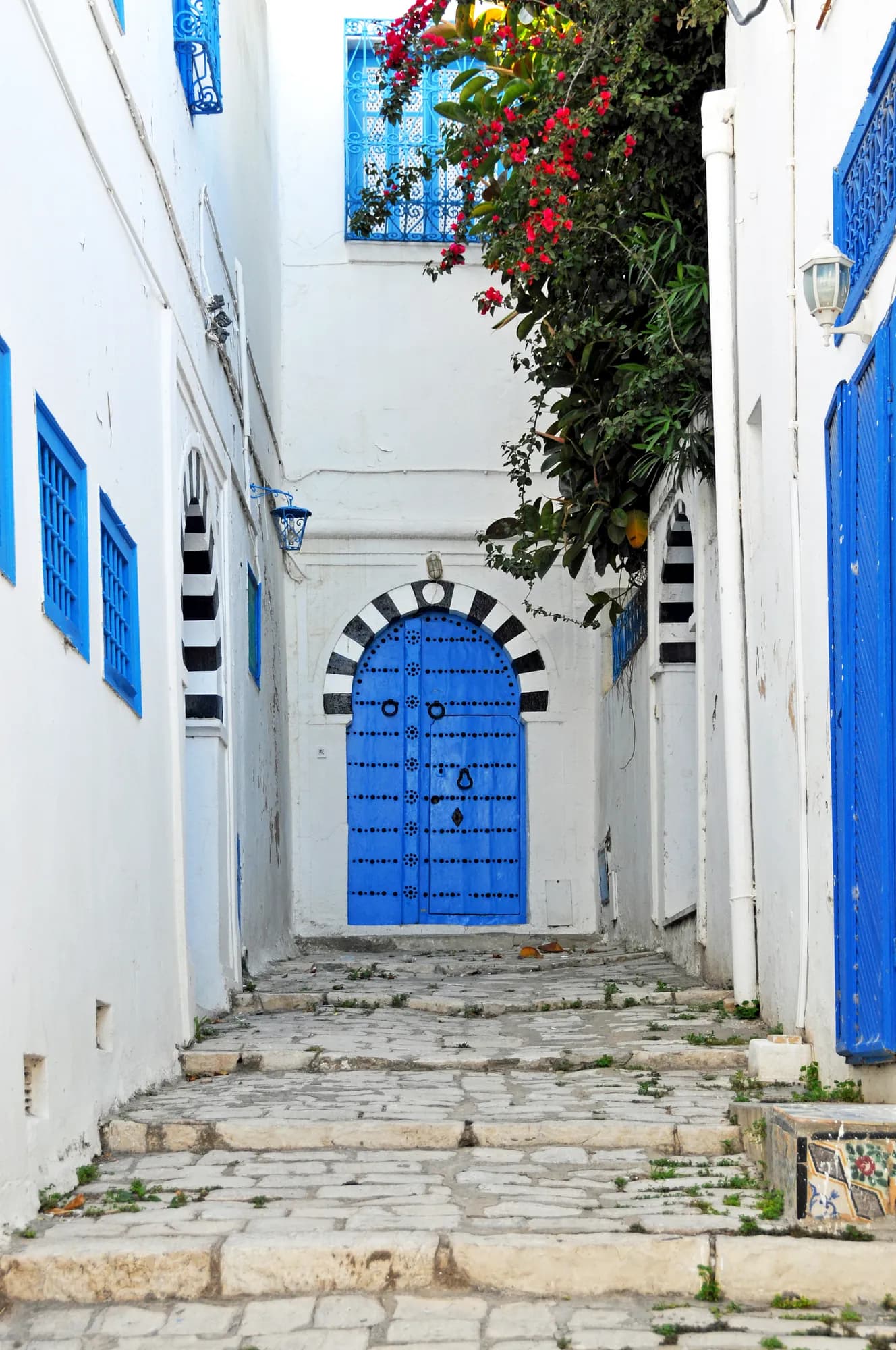
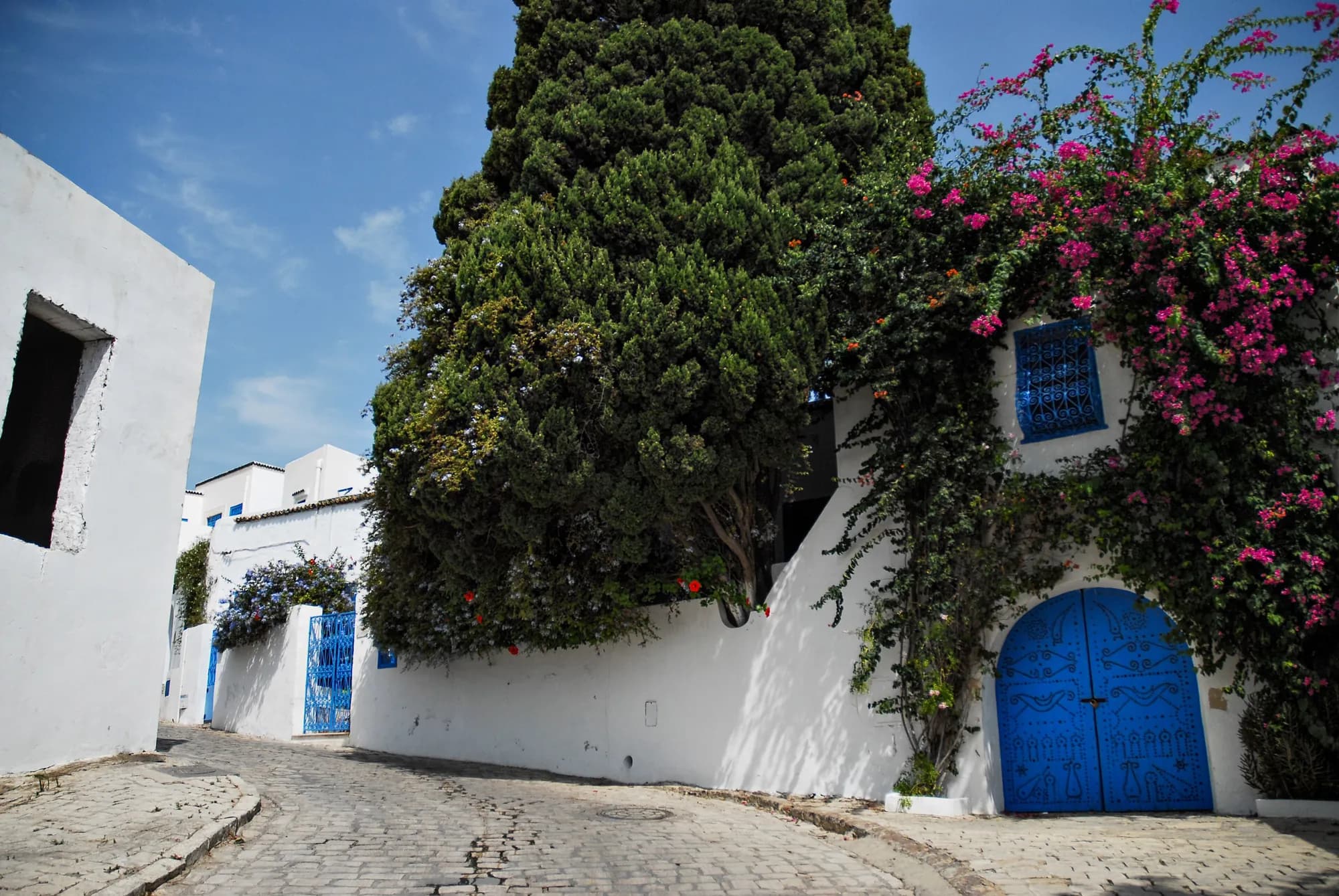
The blue and white colours are protected by a 1915 decree, pushed by the painter and musicologist Baron Rodolphe d'Erlanger. His palace, Ennejma Ezzahra, is now the Centre of Arab and Mediterranean Music and is the finest interior in the village.
At the top, the Café des Délices terraces fall towards the marina; the Café des Nattes on the main steps is older and smaller. Buy a bambalouni, a hot sugared doughnut, from the stalls on the way up.
The best order for a day in Carthage and Sidi Bou Said
Do Carthage in the morning and Sidi Bou Said in the afternoon. The Roman sites are exposed and hot after midday, and the village is at its best with the light on the sea and lunch on a terrace.
09:30 Antonine Baths
Arrive as the gate opens, before the coach groups.
10:30 Byrsa Hill
The museum, the Punic quarter and the view.
11:30 Punic ports and Tophet
Two short stops, five minutes apart by car.
12:30 Sidi Bou Said
Lunch, the main street, Ennejma Ezzahra and a mint tea above the bay.
On our Tunis, Carthage and Sidi Bou Said day the driver adds the medina of Tunis in the morning, and the times shift by about an hour.
How to get to Carthage and Sidi Bou Said
From Tunis, the TGM suburban train stops at several Carthage stations and at Sidi Bou Said, and is cheap but slow and crowded. From the resorts, a car is far simpler, because the Carthage sites are spread out and the train does not reach Hammamet or Sousse.
| From | Drive time | Our trip price per car (1 to 4) |
|---|---|---|
| Tunis | About 30 minutes | €70 |
| Hammamet | About 1 h | €80 |
| Sousse or Port El Kantaoui | About 1 h 30 | €130 |
Common mistakes to avoid
Most disappointments at Carthage come from the same three things.
Trying to see every site
There are more than a dozen. Four good ones beat ten rushed ones.
Arriving in Sidi Bou Said at noon on Sunday
Tunis families come up at weekends. On a weekday the village is calmer.
Wrong shoes
Carthage is gravel and old stone, and Sidi Bou Said is steep cobbles. Wear proper soles.
Questions about Sidi Bou Said and Carthage
What visitors ask before going.
Plan Sidi Bou Said and Carthage in one day
A private car picks you up at your hotel, waits at every site and brings you back by 18:00, with the price fixed for the whole car. Choose your date for Sidi Bou Said and Carthage in one day.